Crystal Palace
|
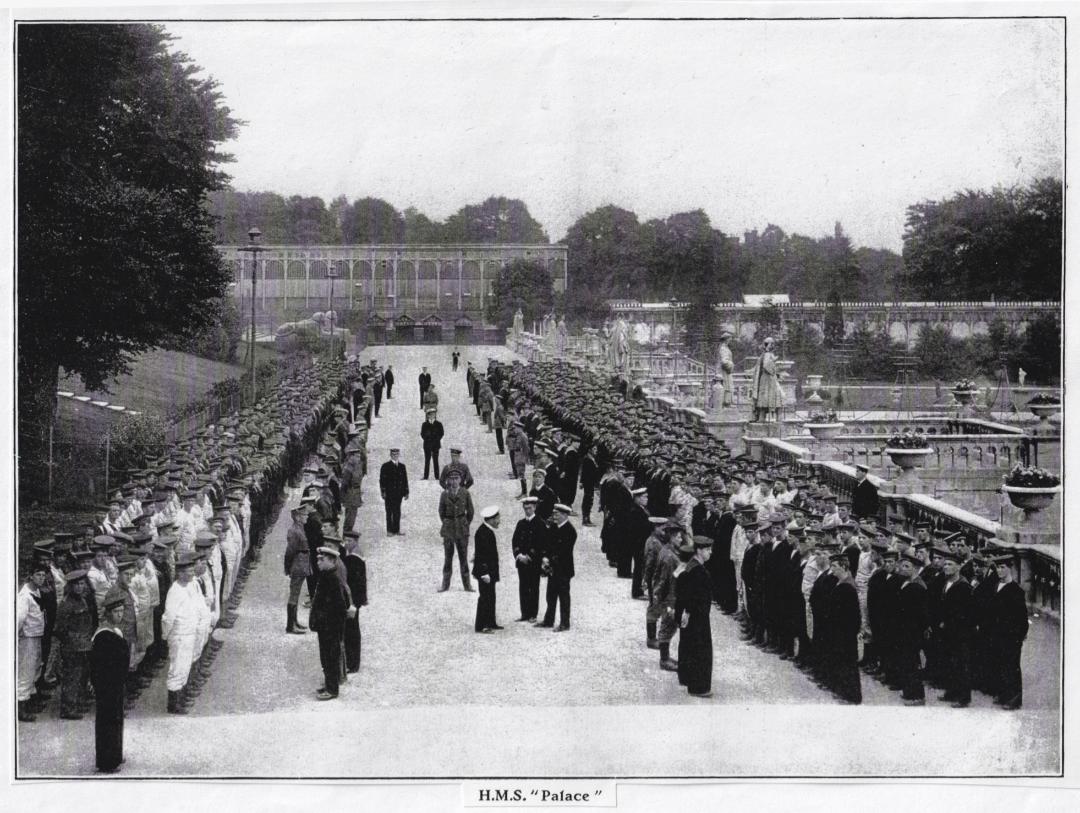
The Admiralty took over the Crystal Palace for training purposes, and from early September a flood of recruits—originally intended for the Army—began to arrive to commence their naval training. The Palace’s numerous buildings and extensive grounds provided an ideal venue for accommodating these men before they moved on to the camp that would shortly be opened at Blandford. Following negotiations between the Admiralty and the Palace’s trustees, it was agreed that the Palace would remain open to the public, including the stalls, although the theatre and certain activities, such as the badminton club, were required to close. Plans were eventually made for more than 7,000 men to be stationed and trained at what would become affectionately known as HMS Crystal Palace. The centre terrace was designated the quarterdeck and a mast was erected. Each morning at 8 o’clock the Union Jack was hoisted and lowered again at nightfall; on both occasions a single note was sounded on the bugle and every man stood to attention facing the flag. Sentries were posted at the main entrance, and after the Palace closed each day all who approached were challenged. Catering for the men stationed there was undertaken by Messrs. Lyons. It was alleged locally that Messrs. Lyons employed Germans, and it was felt by some that it was improper for alien enemies to be catering for British sailors; calls were made for them to be replaced by Belgian refugees. Some concern was expressed regarding the behaviour of the recruits while at the depot. On this matter Sir Richard Williams-Bulkeley, the Commanding Officer of Crystal Palace, stated his complete satisfaction with the men under his charge: “Some of the men, in their spare time, may not be so careful of their behaviour as one might wish, but any harm which might result from their companionship with the opposite sex could be adequately guarded against by mothers and guardians. The whole Brigade are put upon their honour to behave in a manner which brings credit to His Majesty’s Forces, and I am perfectly satisfied that, outside of a few cases, they have amply justified the high opinion I have of them.” |
|
|||||
|
The YMCA provided rest and recreation facilities, including reading and writing rooms, educational and Bible classes, and concerts held every weekend. Sport—particularly football, with a team for each of the sixteen companies—was another major recreational outlet. The YMCA also undertook laundry duties and provided instruction in ambulance work. A bank and post office operated on site, the latter handling an average of 1,800 letters each day. On 16th November 1914 the Royal Standard was raised on the quarterdeck during a visit by the King. After inspecting the grounds and buildings, His Majesty expressed great pleasure at the work being undertaken there. 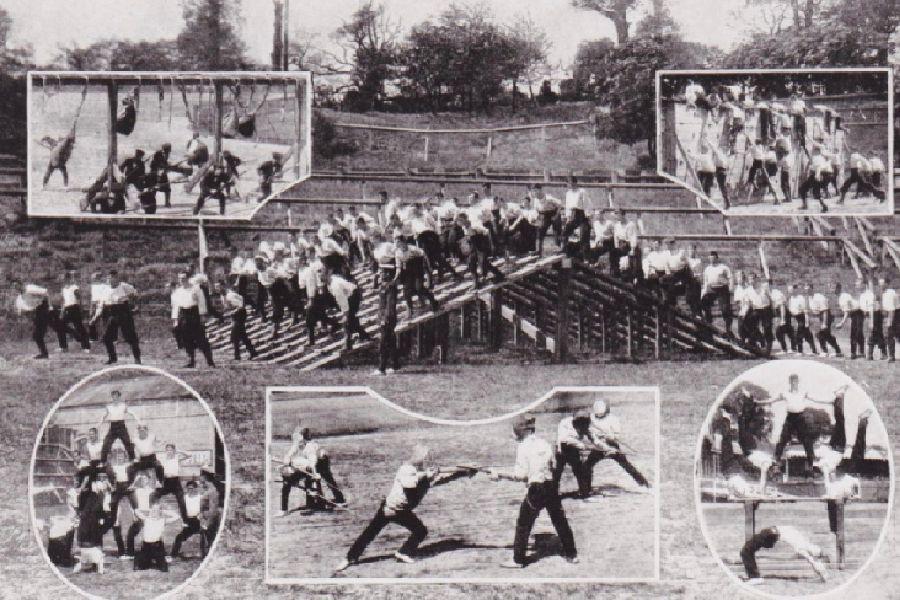
Physical Training Once kitted out following recruitment, men destined for the Sea Draft were placed in a Miscellaneous Battalion under its own officers and petty officers, where they received instruction in squad drill. Men intended for the Royal Naval Division were formed into squads of twenty to thirty men, remaining together until they passed out of the depot for Blandford. Each squad was commanded by a Petty Officer, assisted by a Leading Seaman, who remained with the men throughout their time at Crystal Palace and acted as a father figure. The training process was kept under constant review, with regular assessments to identify potential improvements. An article in The Southern Reporter of 25th November 1915 described the scene:
In 1916 the Wesleyan Magazine reported:
| ||||||
