RND Memorial
| Immediately after the war, a Royal Naval Division Association was formed by former members of the Division under the chairmanship of Arthur Melland Asquith. Its purpose was to create a permanent monument to the Division in London, funded by public subscription. | |||||
| The original intention had been for the memorial to form part of a large Royal Navy monument proposed for Trafalgar Square. When the Admiralty abandoned this plan in favour of three coastal memorials across the south of England, the Association resolved to proceed independently. The Office of Works considered that the Association’s budget of £3,000 would not be sufficient to produce a monument of suitable scale for Trafalgar Square, and alternative sites were explored. A proposed position on the Victoria Embankment was rejected by the Association. Asquith approached Sir Edwin Lutyens, whose recent work included the Cenotaph on Whitehall and projects for the Imperial War Graves Commission. Lutyens entered discussions with the Office of Works and proposed a fountain to be placed at the rear of the Admiralty Extension building, facing St James’s Park. Because previous war memorials in Royal Parks had proved controversial, the design was required to be described officially as “a purely sylvan piece of architecture”. The Association accepted the site. |
|
||||
|
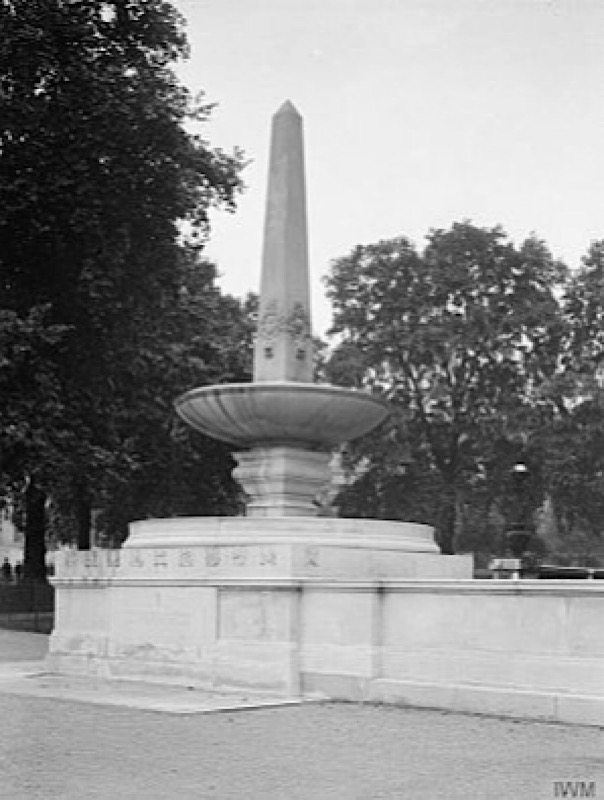
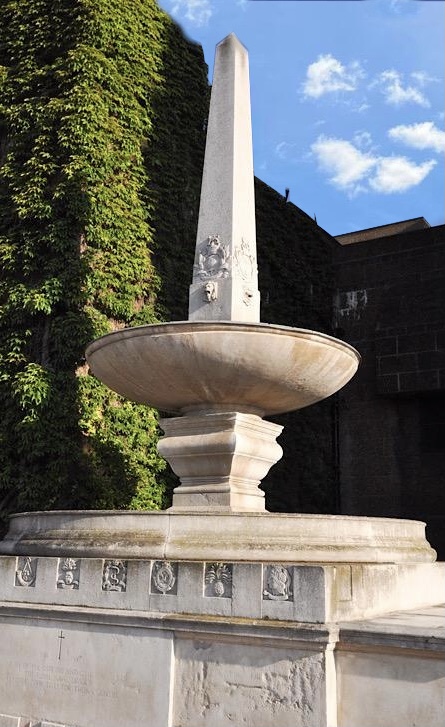
Lutyens submitted drawings for the fountain in May 1924. Provisional approval for the position — on the balustrade at the south-west corner of the Admiralty Extension — was granted in July, and shortly afterwards King George V gave final approval for both the design and the location. Carved from Portland stone, the memorial takes the form of an obelisk rising from a circular bowl. This is supported by a square base connecting to a second, shallower bowl, all set upon a square plinth. Each face of the obelisk bears a relief of the Division’s insignia above a lion’s head, the mouths of which form water spouts feeding the upper basin. Water then overflows into the lower bowl. |
||||
|
Twenty carved battalion badges decorate the plinth, alongside the names Benbow and Collingwood. Central panels carry the dedication, the Division’s battle honours, and lines from the poem The Dead. The memorial was unveiled on 25th April 1925 — the tenth anniversary of the Gallipoli landings — by Major-General Sir Archibald Paris. Winston Churchill delivered an address, and the dedication was performed by the Reverend Bevin Close. Surplus funds from the public subscription were placed into a charitable trust for the memorial’s upkeep, again under Asquith’s chairmanship. | |||||
|
Soon after unveiling, it was discovered that the upper bowl was not level, causing water to overflow unevenly and waterlog the surrounding ground. Repairs were undertaken, and in 1928 the Office of Works agreed to assume responsibility for future maintenance. The memorial remained in place until 1939, when construction of the Admiralty Citadel required its dismantling and storage for protection. |
|
||||
|
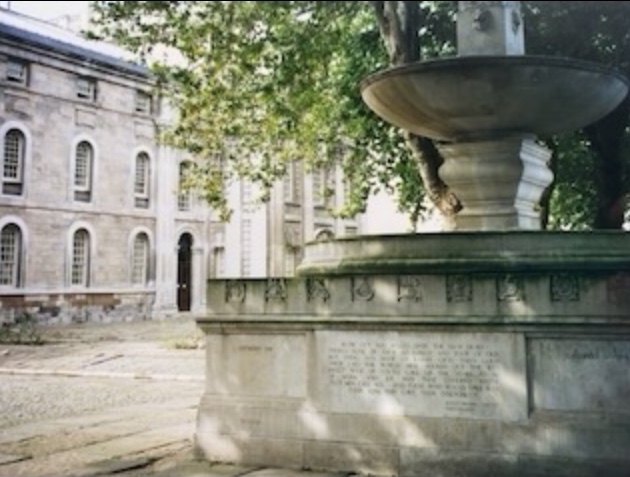
Following the end of the Second World War, the Association pressed for its reinstatement. The Ministry of Works, successor to the Office of Works, concluded that the original position was no longer suitable and began considering alternatives. In 1949 it was agreed that the memorial would be re-erected in the grounds of the Royal Naval College, Greenwich, beside the Queen Anne Building. It was unveiled there on 26th May 1951 by Vice-Admiral Alexander Madden, Second Sea Lord. | ||||
|
Until 1981 annual reunions of the RND Association occured at the college with the memorial as the centrepece, but with the planned closure of the college in 1998, Captain Christopher Page RN began a campaign to have the memorial returned to its original setting near Horse Guards Parade. A fund was established to meet the cost of approximatly £150,000. HRH Prince Charles agreed to be the patron of the committee to relocate the memorial. The original plinth, along with the pipework, still existed and was in good order. The memorial was reinstalled with the Admiralty Citadel forming its backdrop, and was unveiled in its restored position by the Prince of Wales on 13th November 2003 — the eighty-seventh anniversary of the Division’s attack at Beaucourt. In 2008 the memorial received Grade II listed status, which was upgraded to Grade II* in 2015. Further restoration work culminated in a rededication ceremony on 13th November 2025. Order of Service and the memorial at Greenwich image courtsy of the Sterndale Bennett family. |
|||||